12. The role of oil and plant fats in insulin resistance
When it comes to diabetes, the research is clear: Whole-food, plant-based diets can help prevent diabetes, slow its progression, and improve key health markers. But if your goal is reversal, there’s an important detail to understand.
As we learned, it’s the low-fat component of a whole-food, plant-based diet that shows the most consistent benefits for improving and reversing insulin resistance—typically keeping fat intake around 10–15% of total energy.
How do you know if your diet is low in fat?
You could track intake to hit that 10–15% range, but there’s a simpler, more sustainable approach: remove oil. Cutting out oils and added fats from cooking, salad dressings, and meals is one of the quickest ways to lower fat intake and support disease reversal.
👉 Download our ‘Cooking without oil’ guide for practical tips and techniques.
Why oil matters
Even though oils come from plants, they are highly processed and almost entirely fat. This makes them:
- Extremely calorie-dense
- Low in fibre
- Easy to overuse
This matters metabolically. For people aiming to reverse insulin resistance, oil is essentially pure fat, contributing no essential nutrients and working against a low-fat eating pattern.
For example, 1 tablespoon of oil contains 14 grams of fat (about the same as a small cheeseburger) and around 120 empty calories (no fibre, minimal nutrients).
If your daily fat target is 10–15% of total energy (about 22–30 grams per day), just 2 tablespoons of oil could use up half or more of your daily allowance. That leaves very little room for natural fats in whole plant foods, making a truly low-fat diet hard to maintain if oil is used regularly.
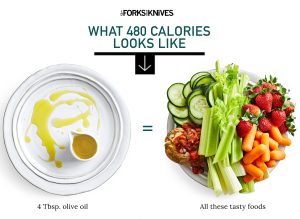
For the same number of calories as 1 tablespoon of oil, you could enjoy:
- 1½ bananas
- 3 cups of strawberries
- 1 large baked potato
- A full bowl of lentil soup
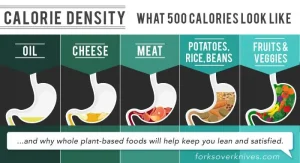
These visuals from Forks Over Knives highlight how much more filling and nutrient-dense whole plant foods are compared with oil or animal products.
What about other plant fats?
For those seeking the most dramatic improvements—especially during reversal—it’s best to limit or temporarily avoid higher-fat plant foods, such as:
- Nuts
- Seeds
- Avocado
These fall into the Yellow Light food category, and should be eaten only occasionally during the reversal phase.
Exception: Include 1–2 tablespoons per day of ground flaxseeds, chia seeds, or hemp seeds. Ground flaxseeds are the top recommendation. These can be added to oats, smoothies, or other meals to provide a steady source of omega-3 fatty acids, which are important for cardiovascular and overall health.
A note on going low-fat
Transitioning to a low-fat whole food plant-based diet is effective for improving and reversing insulin resistance. Depending on your current level of insulin resistance, you may wish to start gradually.
Always speak with your doctor before making significant dietary changes. Continuing to eat a high-fat diet while adding more carbohydrates can raise your blood glucose levels, while rapid improvements from lowering dietary fat can cause blood glucose to drop quickly. For those using insulin or sulfonylurea medications (which stimulate the pancreas to produce more insulin), it’s particularly important to make these changes under medical guidance so that medication doses can be adjusted safely.
American College of Lifestyle Medicine. The benefits of plant-based nutrition: Treatment and prevention of type 2 diabetes. https://lifestylemedicine.org/benefits-plant-based-nutrition-type2-diabetes/
Current Diabetes Reports. The influence of dietary fat on insulin resistance. https://pubmed.ncbi.nlm.nih.gov/12643169/
Current Opinion in Lipidology. Free fatty acids and skeletal muscle insulin resistance. https://pubmed.ncbi.nlm.nih.gov/18460913/
Diabetes. Rapid impairment of skeletal muscle glucose transport/phosphorylation by free fatty acids in humans. https://pubmed.ncbi.nlm.nih.gov/10334314/
Diabetes Care. Dietary Fat Acutely Increases Glucose Concentrations and Insulin Requirements in Patients With Type 1 Diabetes: Implications for carbohydrate-based bolus dose calculation and intensive diabetes management. https://diabetesjournals.org/care/article/36/4/810/37916/Dietary-Fat-Acutely-Increases-Glucose
JAMA Internal Medicine. Association Between Plant-Based Dietary Patterns and Risk of Type 2 Diabetes: A Systematic Review and Meta-analysis. https://jamanetwork.com/journals/jamainternalmedicine/fullarticle/2738784
Journal of Geriatric Cardiology. A plant-based diet for the prevention and treatment of type 2 diabetes. https://pmc.ncbi.nlm.nih.gov/articles/PMC5466941/
Journal of the American Heart Association. Recipe for Heart Health: A Randomized Crossover Trial on Cardiometabolic Effects of Extra Virgin Olive Oil Within a Whole-Food Plant-Based Vegan Diet. https://pubmed.ncbi.nlm.nih.gov/39045758/
Nutrients. A Plant-Based Dietary Intervention Improves Beta-Cell Function and Insulin Resistance in Overweight Adults: A 16-Week Randomized Clinical Trial. https://www.mdpi.com/2072-6643/10/2/189
Nutrients. Fat Quantity and Quality, as Part of a Low-Fat, Vegan Diet, Are Associated with Changes in Body Composition, Insulin Resistance, and Insulin Secretion. A 16-Week Randomized Controlled Trial. https://www.mdpi.com/2072-6643/11/3/615